Packet Processing
NetKAT: Network Verification
while(ttl > 0) {
  if (dst == 10.0.0.101) {
    vlan = 200
    ttl = ttl - 1
    switch = S4
  }
  ...
}Key Insight
Network behavior = Program execution
- Packet field = local variable
- Match rule = if statement
- Action = variable update
- Multi-hop = loops
- Verification = program equivalence
NetKAT: Kleene algebra with tests for network verification
NetKAT Limitations
Fixed number of fields with fixed number of bits
- ❌ No variable-length data
- ❌ Doesn't model packet parsing
- ❌ Cannot handle tunneling
- ❌ Cannot handle SR / MPLS
- ❌ Cannot model unbounded state
- ❌ Limited to finite-state verification
StacKAT: Infinite State Modeling
StacKAT extends NetKAT with a stack to model variable-length payload data
StacKAT: Packet Processing with Payload
The StacKAT Language
push(n) | pop(n)
NetKAT Operations
| 0 | Drop packet (fail) |
| 1 | Forward packet (skip) |
| e₁ + e₂ | Non-deterministic choice |
| e₁ · e₂ | Sequential composition |
| e* | Kleene star (iteration) |
| f := n | Set field f to constant n |
| f == n | Test field f equals n |
StacKAT Extensions
| push(n) | Push constant n onto stack |
| pop(n) | Pop from stack, test if equals n |
Key insight: Stack operations enable modeling of variable-length data and unbounded state
Stack Operations
push(3)
pop(3)
pop(5) - Test fails
pop(3) - Empty stack
Common Programming Patterns
StacKAT Semantics
A StacKAT program defines a relation between input and output packets
Each input packet is mapped to zero or more output packets
packet dropped
deterministic
non-deterministic
Compositional Semantics
| Sequencing: | ⟦e₁ · e₂⟧ = ⟦e₁⟧ ∘ ⟦e₂⟧ | Relation composition |
| Choice: | ⟦e₁ + e₂⟧ = ⟦e₁⟧ ∪ ⟦e₂⟧ | Relation union |
| Kleene star: | ⟦e*⟧ = ⟦e⟧* | Reflexive transitive closure |
| Field test: | ⟦f == n⟧ | Filter packets where field f equals n |
| Field update: | ⟦f := n⟧ | Set field f to value n |
| Push: | ⟦push(n)⟧ | Push constant n onto stack |
| Pop: | ⟦pop(n)⟧ | Pop and test equals n |
The Key Verification Question
Is ⟦e₁⟧ = ⟦e₂⟧ ?
Do two programs have the same semantics?
NetKAT
- Finite number of possible packets
- Finite-state automata
- ✓ Decidable (PSPACE-complete)
StacKAT
- Unbounded stack size
- Infinite number of possible packets
- Decidable or undecidable?
Basic StacKAT Equivalences
A Surprising Equivalence
Why? After push-pop cancellation, the net effect is either:
• Only pushes remain (if more pushes than pops)
• Only pops remain (if more pops than pushes)
• Nothing remains (if equal pushes and pops)
Which Programs are Equivalent?
Interactive Demo
Verification Algorithm
StacKAT Programpush(3)* · pop(3)*
|
→
Convert
|
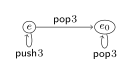
|
|
Step 1
|
Push-pop closure
Add ε-transitions
|
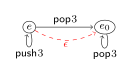
|
|
Step 2
|
Pop-push filtering
Intersect with pop*push*
|
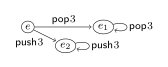
|
|
Step 3
|
Zipping
Normalized automaton
|
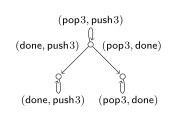
|
Step 0: Creating the Automaton
Idea: use small-step rules to generate finite automata
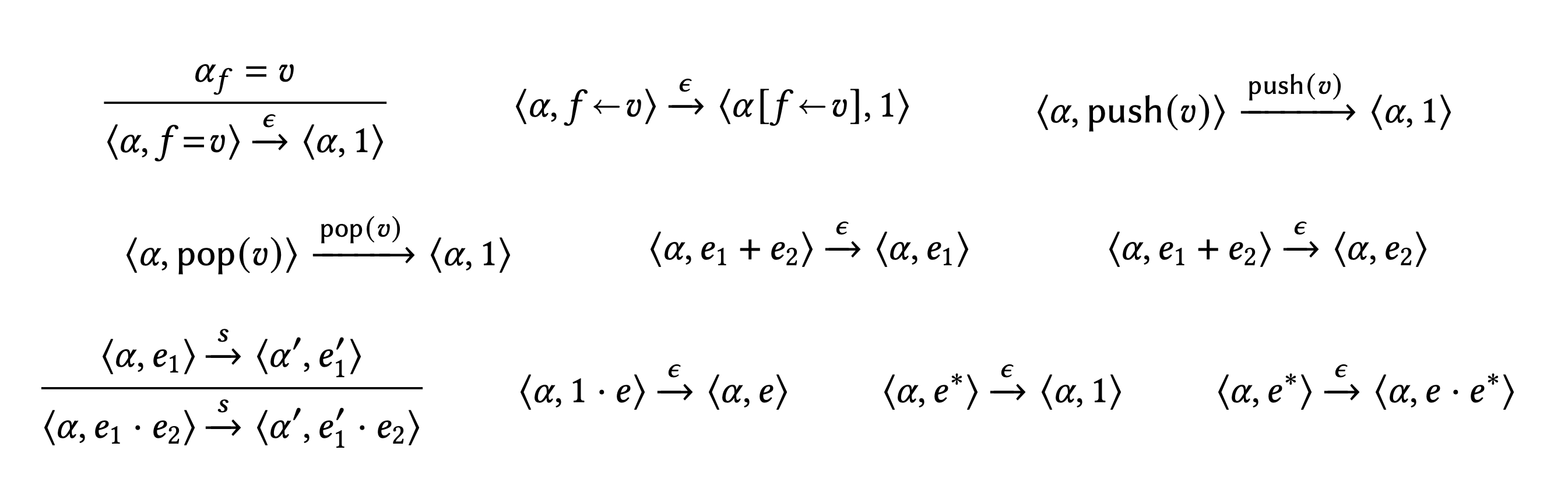
State is ⟨header fields, expression⟩ → finite state!
Stack handled via labeled transitions
Step 1: Push-Pop Closure
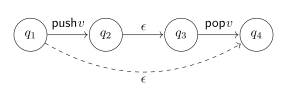
Rule 1: Add epsilon shortcut when push(v) followed by pop(v)
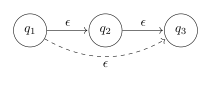
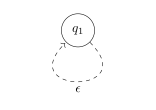
Rule 2: Maintain transitive reflexive closure of ε edges
Step 2: Pop-Push Filtering
Intersect automaton with pop*push* language:
|
|
→ |
|
Cancels out matching push(v) pop(v) transitions
Step 3: Zipping the Automaton
Run the automaton "middle-out",
synchronizing push and pop actions
|
Initial
|
After pop-push filtering
|
|
|
Step 1
|
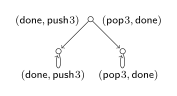
Zip automaton
Pairs represent synchronized inside-out actions
|
|
|
Step 2
|
Add initial-stack self-loops
Final normalized automaton
|
|
Aside: Visibly Pushdown Languages
VPLs
- ✓ Restricted stack behavior
- ✓ Separate input tape
StacKAT
- ✓ Unrestricted stack behavior
- ✓ Input = initial stack (packet)
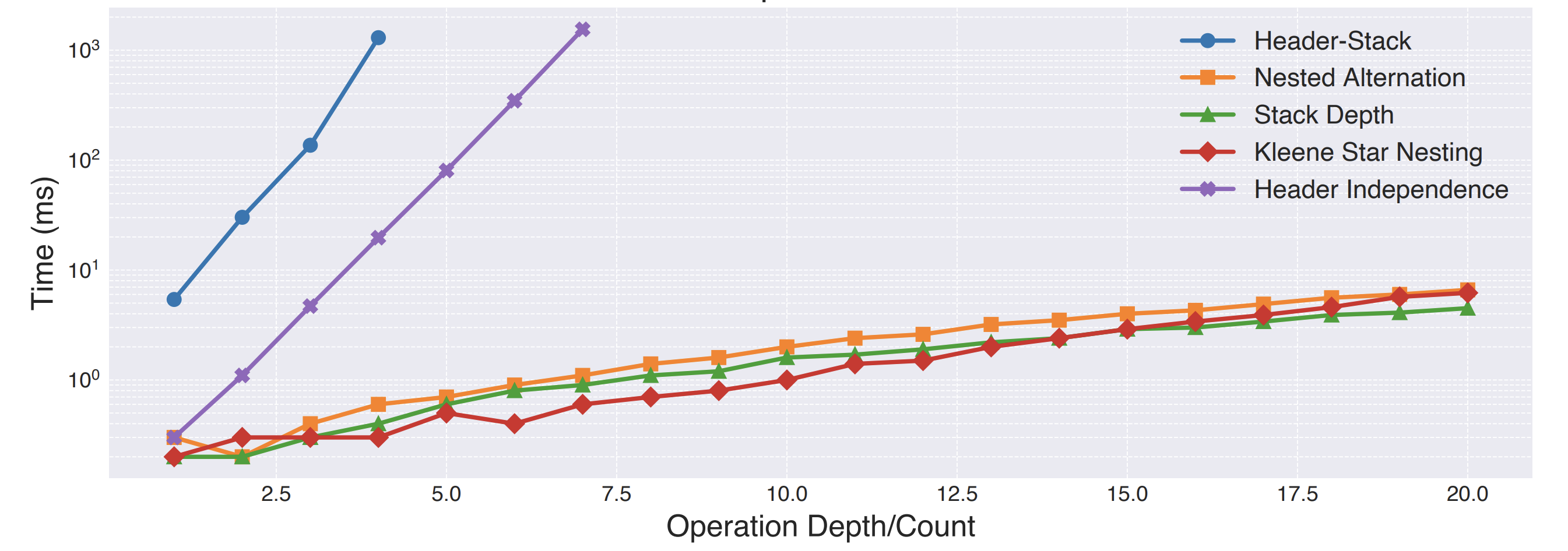
Time Complexity
Performance
Complete Axiomatization
Ideal Axioms
push(v)⋅pop(v) ≡ 1
push(v)⋅pop(w) ≡ 0 (v ≠ w)
pop(v)⋅push(v) ≤ 1
Current Axioms
push(v)⋅pop(v) ≡ 1
push(v)⋅pop(w) ≡ 0 (v ≠ w)
(ugly third axiom hidden)
Future work: are the ideal axioms complete?
Conclusion
StacKAT is a new model for unbounded packet processing with decidable equivalence
Future Work
Goal: verification of real world large networks