Jules Jacobs · Publications
StacKAT: Infinite State Network Verification
Jules Jacobs, Nate Foster, Tobias Kappé, Dexter Kozen, Lily Saada, Alexandra Silva and Jana Wagemaker. PLDI'25.
Network behaviors such as parsing, source routing and telemetry are difficult or impossible to model in NetKAT. StacKAT adds a stack with push and pop, standing for a packet's contents still to be parsed. The paper gives a decision procedure for StacKAT program equivalence based on finite automata, which produces counterexamples, and a complete axiomatization.
 Read the paper
Abstract
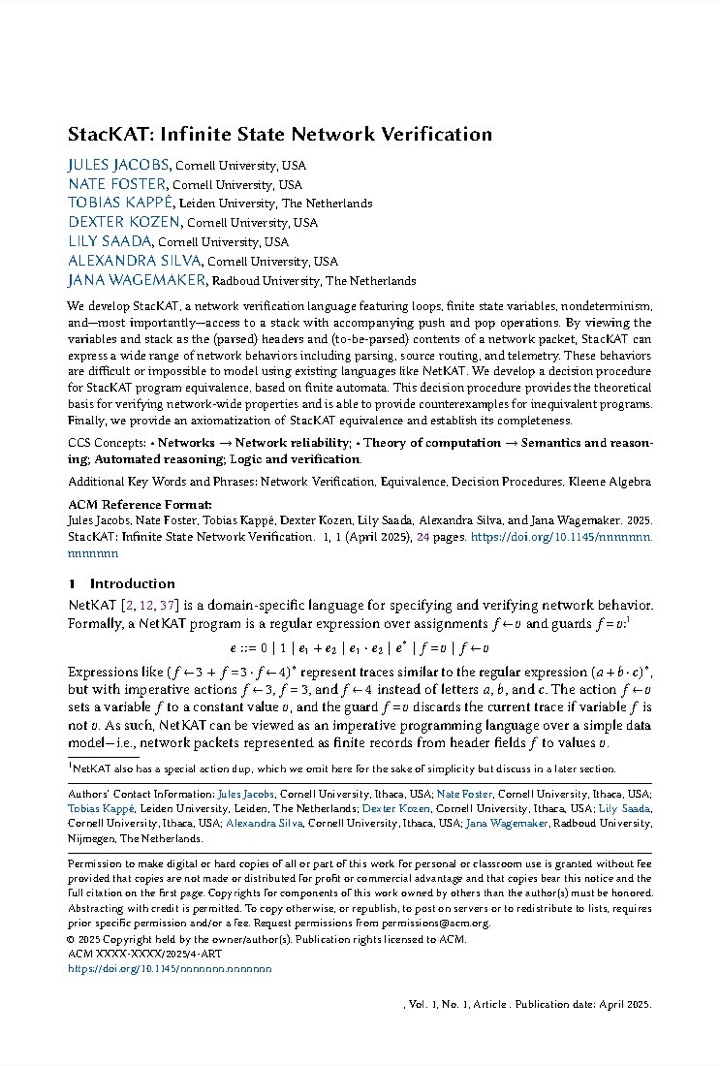
We develop StacKAT, a network verification language featuring loops, finite state variables, nondeterminism, and—most importantly—access to a stack with accompanying push and pop operations. By viewing the variables and stack as the (parsed) headers and (to-be-parsed) contents of a network packet, StacKAT can express a wide range of network behaviors including parsing, source routing, and telemetry. These behaviors are difficult or impossible to model using existing languages like NetKAT. We develop a decision procedure for StacKAT program equivalence, based on finite automata. This decision procedure provides the theoretical basis for verifying network-wide properties and is able to provide counterexamples for inequivalent programs. Finally, we provide an axiomatization of StacKAT equivalence and establish its completeness.
Talks
Cite
@article{jacobs2025stackat,
  title = {StacKAT: Infinite State Network Verification},
  volume = {9},
  ISSN = {2475-1421},
  url = {https://doi.org/10.1145/3729257},
  DOI = {10.1145/3729257},
  number = {PLDI},
  journal = {Proceedings of the ACM on Programming Languages},
  publisher = {Association for Computing Machinery (ACM)},
  author = {Jacobs, Jules and Foster, Nate and Kappé, Tobias and Kozen, Dexter and Saada, Lily and Silva, Alexandra and Wagemaker, Jana},
  year = {2025},
  month = June,
  pages = {277--300}
}